Evidence-based, parent-tested. References guidelines from the AAP, CDC, and WHO.
Informational only, not medical advice. Always consult your pediatrician about your baby's specific needs.
Baby Fine Motor Skills: Development Stages and Activities by Age
Fine motor skills — the small, precise movements of the hands and fingers — are among the most important abilities your baby will develop during their first two years of life. These skills lay the foundation for virtually everything your child will do with their hands, from feeding themselves to drawing pictures, buttoning their shirt, and eventually writing their name.
Understanding how fine motor skills develop and knowing which activities support that development gives you practical tools to help your baby build these critical abilities through everyday play.
📌 Key Takeaway: According to La Leche League International, breastfed babies typically nurse 8-12 times in 24 hours during the first weeks. This guide gives you evidence-based, practical guidance you can apply today. For a related deep dive, see our guide on baby brain development nutrition.
What Are Fine Motor Skills?
Fine motor skills involve the coordination of small muscles in the hands and fingers, working together with the eyes. They differ from gross motor skills, which involve the large muscles used for movements like crawling, sitting, and walking.
Fine motor skills include:
- Grasping and releasing objects
- Hand-eye coordination (reaching for and picking up what you see)
- Bilateral coordination (using both hands together)
- In-hand manipulation (moving objects within one hand)
- Finger isolation (using individual fingers independently)
- Hand strength and dexterity
These skills are essential for:
- Self-feeding (finger foods, utensils, drinking from a cup)
- Dressing (zippers, buttons, snaps)
- Playing (building blocks, puzzles, crayons)
- Self-care (brushing teeth, washing hands)
- Academic skills (writing, cutting with scissors, turning pages)
The Stages of Grasp Development
One of the clearest ways to track fine motor development is through grasp progression. Babies move through a predictable sequence of grasp patterns, each more refined than the last.
Reflexive Grasp (Birth to 2 Months)
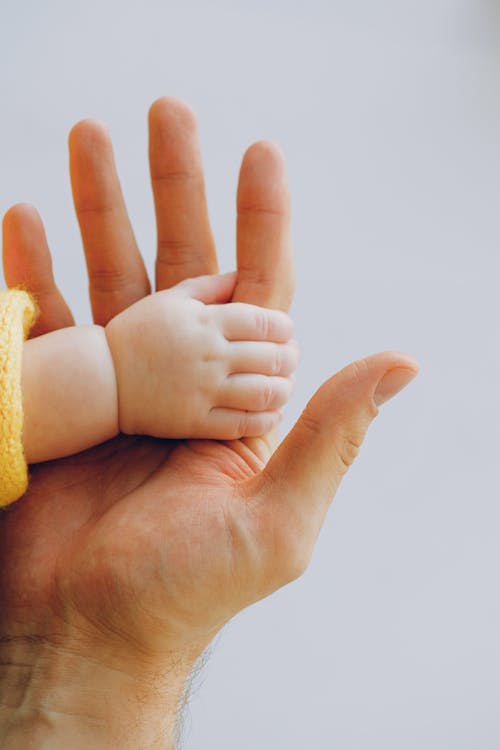
The first grasp is not voluntary at all. Newborns have a palmar grasp reflex — when something touches their palm, their fingers automatically close around it. This reflex is so strong that a newborn can briefly support their own weight when gripping a finger or rod. The reflexive grasp begins to fade around 2 to 3 months as voluntary grasping develops.
What it looks like: Baby’s hand closes tightly around anything placed in the palm. Hands are mostly fisted at rest.
Ulnar Palmar Grasp (3-4 Months)
As the reflexive grasp fades, the first voluntary grasping pattern emerges. The baby uses the pinky side of the hand to press objects against the palm. The grasp is crude and not very precise, but it is intentional.
What it looks like: Baby reaches for and holds objects but uses the outer fingers and palm, wrapping the pinky and ring fingers around the object. The thumb is not actively involved.
Palmar Grasp (4-6 Months)
The palmar grasp is a whole-hand grip where all four fingers squeeze an object against the palm. The thumb begins to participate but still wraps over the object rather than opposing the fingers.
What it looks like: Baby wraps entire hand around an object (like a rattle or block), squeezing it against the palm. Can hold objects securely and begins to transfer them from hand to hand.
Radial Palmar Grasp (5-7 Months)
The grasp shifts to the thumb side (radial side) of the hand. The thumb, index, and middle fingers become the primary grasping fingers, though the palm is still involved.
What it looks like: Baby uses the thumb side of the hand to pick up objects. The grip is more refined, and the baby can manipulate objects with greater control.
Raking Grasp (6-8 Months)
When trying to pick up small objects, the baby uses a raking motion, scraping all four fingers toward the palm to scoop up the item. This is like trying to pick up a pea by scratching it toward you.
What it looks like: Baby uses all four fingers in a scratching motion to drag small objects toward the palm. Not yet able to isolate individual fingers.
Inferior Pincer Grasp (7-9 Months)
The pincer grasp begins to emerge, but in its early form. The baby uses the pads (flat parts) of the thumb and index finger to pick up objects, rather than the fingertips.
What it looks like: Baby picks up small objects using the flat surface of the thumb and the side or pad of the index finger. The object is held closer to the palm than the fingertips.
Neat Pincer Grasp (9-12 Months)
The mature pincer grasp is a hallmark fine motor milestone. The baby uses the very tips of the thumb and index finger to pick up small objects with precision.
What it looks like: Baby picks up tiny objects (like a Cheerio or small bead) using only the tips of the thumb and index finger, holding it away from the palm. This is a highly precise grip that requires significant finger coordination.
Beyond the Pincer: Advanced Grasps (12-24 Months)
After mastering the pincer grasp, toddlers develop increasingly sophisticated hand skills:
| Age | Grasp/Skill | Description |
|---|---|---|
| 12-15 months | Digital pronate grasp | Holds crayon in fist with the thumb on top; whole-arm movement for scribbling |
| 12-18 months | Controlled release | Can place objects precisely rather than just dropping them |
| 15-18 months | Builds tower of 2-3 blocks | Demonstrates controlled release and hand-eye coordination |
| 18-24 months | Builds tower of 4-6 blocks | Increased precision and steadiness |
| 18-24 months | Turns pages one at a time | Requires isolated finger movement and bilateral coordination |
| 20-24 months | Beginning to use utensils | Holds spoon with fisted grip but can bring food to mouth |
Fine Motor Milestones by Age
0-3 Months
- Hands are mostly fisted at rest (opens gradually)
- Reflexive grasp when palm is stimulated
- Brings hands to mouth
- Swipes at dangling objects (not always accurately)
- Holds a rattle briefly when placed in hand
- Begins to look at own hands with fascination
3-6 Months
- Reaches for and grasps objects intentionally
- Holds objects with palmar grasp
- Transfers objects from one hand to the other (by 5-6 months)
- Brings objects to mouth for exploration
- Shakes rattles and toys
- Uses both hands to hold larger objects
- Begins to rake at small objects on a surface
6-9 Months
- Picks up small objects using raking grasp
- Transfers objects easily between hands
- Bangs objects on surfaces and together
- Pokes at objects with index finger
- Inferior pincer grasp develops
- Drops objects intentionally (and loves watching them fall)
- Can hold a bottle or sippy cup
- Begins to feed self finger foods
9-12 Months
- Neat pincer grasp mastered
- Picks up tiny objects with precision
- Points with index finger
- Pokes, prods, and explores with isolated finger movements
- Puts objects into containers and dumps them out
- Begins to stack objects (may stack 1-2 blocks)
- Turns pages of a board book (several at a time)
- Claps hands together
- Bangs two objects together intentionally
12-18 Months
- Builds tower of 2-3 blocks
- Scribbles with crayons (fisted grip, whole-arm movement)
- Feeds self with fingers competently
- Begins to use a spoon (with lots of spilling)
- Drinks from an open cup with some help
- Removes socks and shoes
- Turns pages of a book (2-3 at a time)
- Places shapes in a shape sorter (with practice)
- Uses index finger to point, poke, and explore
18-24 Months
- Builds tower of 4-6 blocks
- Turns pages one at a time
- Holds crayon with more refined grip
- Makes vertical and horizontal strokes (not just scribbles)
- Uses spoon and fork with decreasing spillage
- Begins to drink from open cup independently
- Strings large beads on a thick cord
- Turns doorknobs and lids
- Unzips large zippers
- Begins to undress (pulls off hat, socks, shoes)
- Completes simple knob puzzles
Activities to Develop Fine Motor Skills by Age
Activities for 0-3 Months
At this early stage, fine motor development is supported by sensory experiences and encouraging your baby to reach and grasp.
- Finger play: Gently open and close your baby’s hands; massage their fingers and palms
- High-contrast visuals: Hold black-and-white pattern cards near your baby’s hands to encourage reaching
- Grasping practice: Place a lightweight rattle or soft ring toy in your baby’s hand
- Hand-to-mouth: Allow your baby to bring hands to mouth (this is purposeful exploration, not just a habit)
- Tummy time reaching: Place toys just within reach during tummy time
Activities for 3-6 Months
- Reaching and batting: Hang toys from a play gym for your baby to swat and grasp
- Texture exploration: Offer toys with different textures (smooth, bumpy, soft, crinkly)
- Transfer practice: Offer a toy to one hand, then encourage transfer to the other
- Splash play: During bath time, let baby splash and grab at floating toys
- Paper crinkle: Supervised play with tissue paper or crinkly fabric
- Book exploration: Let baby hold, mouth, and turn sturdy board books
Activities for 6-9 Months
- Finger foods: Introduce soft, small finger foods like puffs, small pieces of banana, or cooked peas (great pincer grasp practice)
- Container play: Give your baby a container and objects to put in and dump out
- Banging play: Provide wooden spoons, pots, and drums for banging
- Stacking cups: Show your baby how to stack and nest cups
- Peel-off stickers: Place large stickers on a surface and help baby peel them off
- Water play: Supervised play with cups, scoops, and water in a shallow basin
Activities for 9-12 Months
- Cheerio pick-up: Scatter Cheerios or puffs on a tray for pincer grasp practice
- Stacking blocks: Start with 2-3 soft blocks and show baby how to stack
- Peek-a-boo with scarves: Pull scarves out of a tissue box or container
- Ball rolling: Roll balls back and forth to practice catching and releasing
- Lift-the-flap books: These encourage isolated finger movements
- Simple puzzles: Large knob puzzles with 2-3 pieces
- Musical instruments: Shakers, tambourines, and small drums
Activities for 12-18 Months
- Crayons and paper: Introduce chunky crayons and large paper for first scribbles
- Play dough: Squeezing, poking, and pulling play dough strengthens hand muscles (supervise closely to prevent eating)
- Sorting activities: Sort objects by color or size into different containers
- Shape sorters: Simple shape sorters with basic shapes (circle, square, triangle)
- Stacking rings: Classic ring stackers build hand-eye coordination
- Self-feeding practice: Encourage spoon use at meals (expect messes)
- Water pouring: Supervised play with small cups and water
Activities for 18-24 Months
- Bead stringing: Large beads on a thick string or shoelace
- Tearing paper: Tearing paper into pieces strengthens hand muscles
- Painting: Finger painting or using chunky paintbrushes
- Scooping and pouring: Sand, water, rice, or dried pasta with scoops and containers
- Simple puzzles: Knob puzzles with 4-6 pieces; begin inset puzzles
- Clothespin activities: Squeezing and clipping clothespins onto a container edge
- Turning pages: Reading books together and letting your toddler turn pages
- Zipping and unzipping: Practice with large zippers on jackets or activity boards
- Building with blocks: Tower building, lining up, and knocking down
Toys That Promote Fine Motor Development
Choosing the right toys can make fine motor practice feel like pure play. Here are recommended toys organized by age:
| Age | Recommended Toys |
|---|---|
| 0-3 months | Soft rattles, O-Ball, play gym with dangling toys, high-contrast cards |
| 3-6 months | Textured balls, stacking rings, soft blocks, crinkle books, teething toys |
| 6-9 months | Stacking cups, pop-up toys, ball drop toys, soft books with flaps, activity cubes |
| 9-12 months | Shape sorters, large knob puzzles, nesting cups, ball runs, musical instruments |
| 12-18 months | Chunky crayons, mega blocks, play dough, ring stackers, push-button toys, simple vehicles |
| 18-24 months | Large bead mazes, lacing cards, play kitchen utensils, water tables, simple puzzles, large Lego Duplo |
Features to Look For in Fine Motor Toys
- Variety of textures for sensory exploration
- Different sizes that require adjusting the grip
- Cause-and-effect features (push a button, something happens) for motivation
- Open-ended play possibilities (blocks, cups, and containers are better than single-purpose toys)
- Safety: No small parts for children under 3; check for choking hazards regularly
When to Be Concerned About Fine Motor Delays
Fine motor delays can be subtle and are sometimes overshadowed by more visible gross motor or language concerns. Here are signs that may indicate a need for professional evaluation:
Red Flags by Age
By 3 months:
- Does not bring hands to mouth
- Does not grasp objects placed in hand
- Hands are always tightly fisted (beyond the newborn period)
By 6 months:
- Does not reach for or grasp objects
- Cannot hold objects in hand
- Does not bring objects to mouth
- Does not transfer objects between hands
By 9 months:
- Does not use a raking grasp to pick up small objects
- Cannot hold two objects at once (one in each hand)
- Does not bang objects together
- Does not feed self finger foods
By 12 months:
- Has not developed a pincer grasp
- Cannot pick up small objects
- Does not point with index finger
- Cannot release objects voluntarily
- Does not put objects into containers
By 18 months:
- Cannot stack 2 blocks
- Does not scribble when given a crayon
- Cannot use a spoon at all
- Does not attempt to feed self
By 24 months:
- Cannot stack 4 blocks
- Does not turn pages of a book
- Cannot turn a doorknob
- Shows strong hand preference before 18 months (may indicate weakness on one side)
What to Do If You Have Concerns
- Talk to your pediatrician: Describe the specific skills your child is struggling with
- Request an occupational therapy evaluation: Pediatric occupational therapists (OTs) specialize in fine motor assessment and intervention
- Contact Early Intervention: For children under 3, free evaluation and services are available through your state’s Early Intervention program
- Keep practicing: Continue offering age-appropriate activities at home while seeking professional guidance
Conditions That May Affect Fine Motor Development
Several conditions can impact fine motor skill development:
- Premature birth: Premature babies may take longer to develop fine motor skills (use adjusted age for assessment)
- Low muscle tone (hypotonia): Reduced muscle tone can make grasping and manipulation more difficult
- Developmental coordination disorder (DCD): Difficulty with motor planning and coordination
- Cerebral palsy: Can affect hand function on one or both sides
- Autism spectrum disorder: May involve fine motor challenges alongside other developmental differences
- Sensory processing difficulties: Sensitivity to textures or touch can interfere with fine motor exploration
Tips for Supporting Fine Motor Development at Home
- Follow your baby’s lead: Offer activities based on their current skill level, not their age
- Expect mess: Fine motor practice (especially with food, paint, and play dough) is messy. Embrace it
- Offer daily practice: Short, frequent play sessions are more effective than occasional long ones
- Avoid doing it for them: It is tempting to place the block on the tower for your baby, but the learning happens in the trying
- Celebrate effort: Praise the attempt, not just the result
- Make it functional: Meal times, bath time, and dressing are natural fine motor practice opportunities
- Limit screen time: Swiping and tapping a screen does not develop the same fine motor skills as manipulating real objects
Frequently Asked Questions
At what age should my baby be able to pick up small objects like Cheerios?
Most babies develop the ability to pick up small objects between 8 and 10 months as the pincer grasp matures. Before this, they use a raking motion with all four fingers to scoop up small items. By 9 to 12 months, most babies can use the tips of their thumb and index finger to pick up tiny objects with precision. Always supervise closely with small objects to prevent choking.
Is it normal for my baby to use their left hand more than their right?
Babies typically experiment with both hands throughout the first year and may not show a consistent hand preference until 2 to 3 years of age. If your baby shows a very strong preference for one hand before 18 months, mention it to your pediatrician, as it could sometimes indicate weakness on the other side that warrants evaluation.
My 14-month-old still puts everything in their mouth. Is this normal?
Yes, mouthing objects is a normal part of sensory exploration and typically continues until around 18 to 24 months, gradually decreasing as other forms of exploration (poking, turning, throwing) become more interesting. Mouthing should significantly decrease by age 2. If excessive mouthing persists beyond this age, discuss it with your pediatrician.
How can I help my toddler learn to use a spoon?
Start by offering a pre-loaded spoon (you scoop the food, then hand the spoon to your toddler). Use thick, sticky foods that stay on the spoon easily (yogurt, oatmeal, mashed sweet potato). Let your toddler practice during meals without pressure. Use a suction bowl to keep the bowl in place. Expect significant mess for several months — this is how they learn. Most toddlers become reasonably proficient with a spoon by 18 to 24 months.
Do art activities really help fine motor development?
Absolutely. Drawing, painting, tearing paper, manipulating play dough, and other art activities are excellent for fine motor development. They strengthen hand muscles, improve hand-eye coordination, develop finger isolation, and build bilateral coordination. Even simple scribbling with a crayon is building the foundation for later handwriting. Introduce chunky crayons around 12 months and let your child explore freely without focusing on producing a specific result.
💡 Related Resources: Expecting? Visit our sister site pregnancy.chparenting.com for week-by-week pregnancy guides, prenatal nutrition, and labor preparation.
References
- CDC Developmental Milestones - Centers for Disease Control and Prevention
- HealthyChildren.org: Fine Motor Activities - American Academy of Pediatrics
- Mayo Clinic: Infant Development - Mayo Clinic
- WHO Motor Development Milestones - World Health Organization
- AOTA: Developmental Milestones - American Occupational Therapy Association
- Zero to Three: Fine Motor Development - ZERO TO THREE

Written by
Vega LinFounder & Editor — Mother of 2 (Taiwan)
Vega writes Baby Care Guide from the intersection of evidence-based research (AAP, CDC, WHO) and real parenting experience. Completing her Master's in Digital Innovation at Tunghai University. Read more →
Related articles
Planning baby #2? Visit our pregnancy guide.
Due date calculators, week-by-week tracking, weight gain guides, and expert articles for every trimester of your pregnancy journey.
Visit Pregnancy Guide →